
This post contains affiliate links. If you make a purchase from one of the links, we may earn a commission at no extra cost to you.
Black Pepper: The Tiny Spice That Ruled the World
Look down at your dinner table. There it is. That unassuming little shaker, sitting loyally next to the salt like a sidekick who’s been around so long everyone forgot how impressive they are. Black pepper. We sprinkle it on eggs without thinking. We grind it over pasta on autopilot. We have probably never, not once, stopped to consider that this tiny, wrinkled seed once shaped empires, funded city-states, and was considered as valuable as gold.
Yes. Gold.
Let’s talk about black pepper, really talk about it, because this spice has had a more dramatic life than most of us ever will.
From Jungle Vine to Dinner Table: What Even Is Black Pepper?
Before we get to the wars and the ransoms and the historical drama, let’s get acquainted with the plant itself.
Black pepper comes from Piper nigrum, a flowering vine in the family Piperaceae. It’s a perennial climber that can grow up to 4 meters tall, winding its way up trees, poles, or trellises in warm, humid tropical regions. The vine produces small flowers that develop into clusters of tiny round berries — drupes, technically — each about 5mm across. Those berries are what become peppercorns.
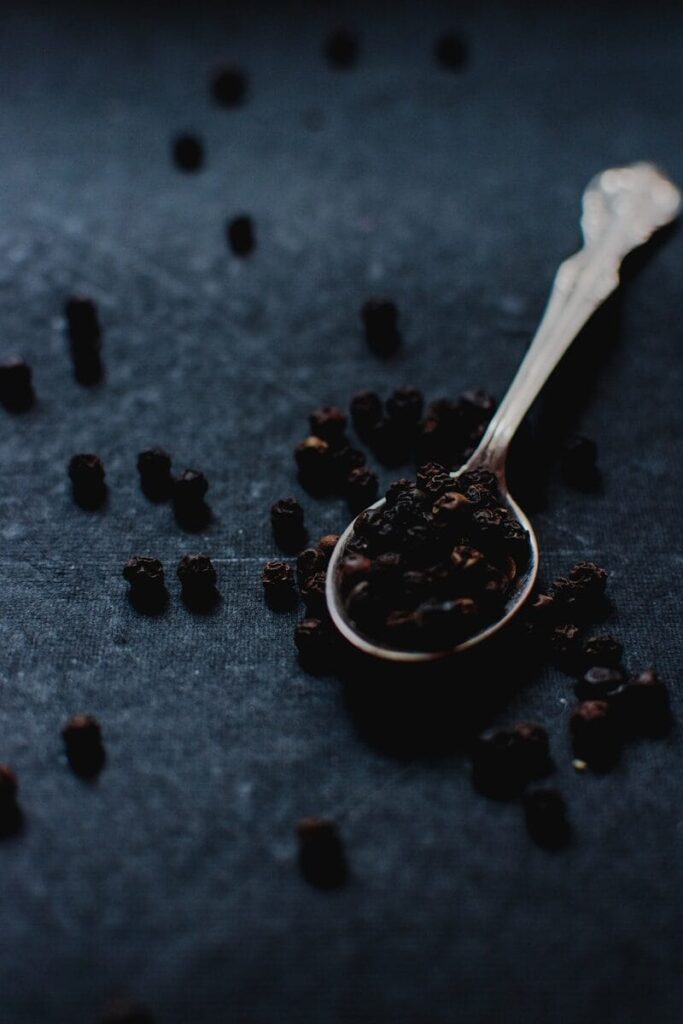
Wait, So Black Pepper Is a… Berry?
Technically, yes. A small, unripe, sun-dried berry. The entire color spectrum of peppercorns, black, white, green, red, all comes from the same plant. The difference is purely about when they’re harvested and how they’re processed.
Black peppercorns are picked while still green and unripe, briefly blanched in hot water (which kickstarts an enzymatic browning process), then dried in the sun for several days. As the skin shrinks and darkens around the seed, you get that familiar wrinkled, brownish-black peppercorn. White pepper? Same plant, but the outer skin is soaked off, leaving just the naked seed — milder, earthier, often preferred in pale sauces where little black specks would cause dinner party anxiety.
The heat of black pepper comes from a compound called piperine, and here’s a fun fact to impress people at brunch: piperine is chemically entirely different from capsaicin, the compound responsible for chili pepper heat. They just both make your mouth feel like it’s having opinions.
“Black Gold”: A History That Absolutely Slaps
Here’s where things get genuinely wild.
Ancient Times: Spice as Currency
Black pepper is native to the Malabar Coast of southern India, specifically the lush tropical region now part of Kerala. Records of its cultivation stretch back to around 1500 BCE, and by the time ancient traders were moving goods along the Silk Road, pepper was already a serious commodity. It traveled across Asia, reached Egypt (where it was apparently used in mummification, because nothing says “luxury” like seasoning a pharaoh), and eventually made its way to the Roman Empire as an expensive, exotic import.
And when we say “valuable,” we mean really valuable. Ancient merchants literally called it “black gold.”
The Middle Ages: Italian Merchants Cash In
After the fall of Rome, Arabic powers took over much of the pepper trade, controlling ports across the Middle East. In Europe, Italian merchants, particularly from Venice and Genoa, became the pepper middlemen of the known world. The profits were so enormous that the pepper trade effectively funded the rise of these city-states. Venice didn’t become a maritime superpower because of its vibes. It was peppercorns.
By the 15th and 16th centuries, the competition to control spice routes was so fierce that it directly motivated the Age of Exploration. Portugal, Spain, England, they weren’t just out there drawing inaccurate maps. They wanted pepper.
The Modern Twist: From Luxury to Afterthought
Here’s the slightly humbling end of the story. As trade routes multiplied and supply increased, pepper prices crashed. The spice that had once graced only the tables of kings slowly made its way to everyone’s kitchen. Today, pepper accounts for roughly 20% of the entire global spice trade, and Vietnam, not India, is now the world’s top producer.
From Visigoth ransom to grocery store impulse buy. What a journey.
The Science Bit (It’s Actually Cool, I Promise)
Piperine isn’t just responsible for the heat. It’s also been studied for its potential to enhance the absorption of other nutrients. You may have seen “black pepper extract” listed in supplement ingredients. This is piperine doing its thing, potentially boosting the bioavailability of compounds like curcumin (the active ingredient in turmeric). It’s why the classic pairing of turmeric and black pepper isn’t just culinary tradition. There’s actual science behind it.
Beyond that, black pepper has been used in traditional medicine for centuries across Indian, Chinese, and Greek traditions: as a digestive aid, an anti-inflammatory, and a general “this will probably help” remedy that our ancestors reached for the way we reach for ibuprofen.
A Few Ways to Actually Taste Your Pepper
If you’ve made it this far, you’re clearly someone who thinks a spice is worth thinking about. Here are some ways to let black pepper actually shine rather than just lurk in the background:

The Humble Shaker Deserves More Respect
So the next time you reach for the pepper mill without thinking, maybe pause for half a second. You’re holding the descendant of a spice that built trade empires, funded Renaissance city-states, and was literally demanded as war ransom.
It crossed oceans before you were born. It outlasted the Roman Empire. It’s been used in cooking, medicine, embalming, and currency — occasionally in the same century.
And now it’s sitting on your table, patiently waiting to make your scrambled eggs slightly more interesting.
That’s not a bad legacy for a dried berry.